
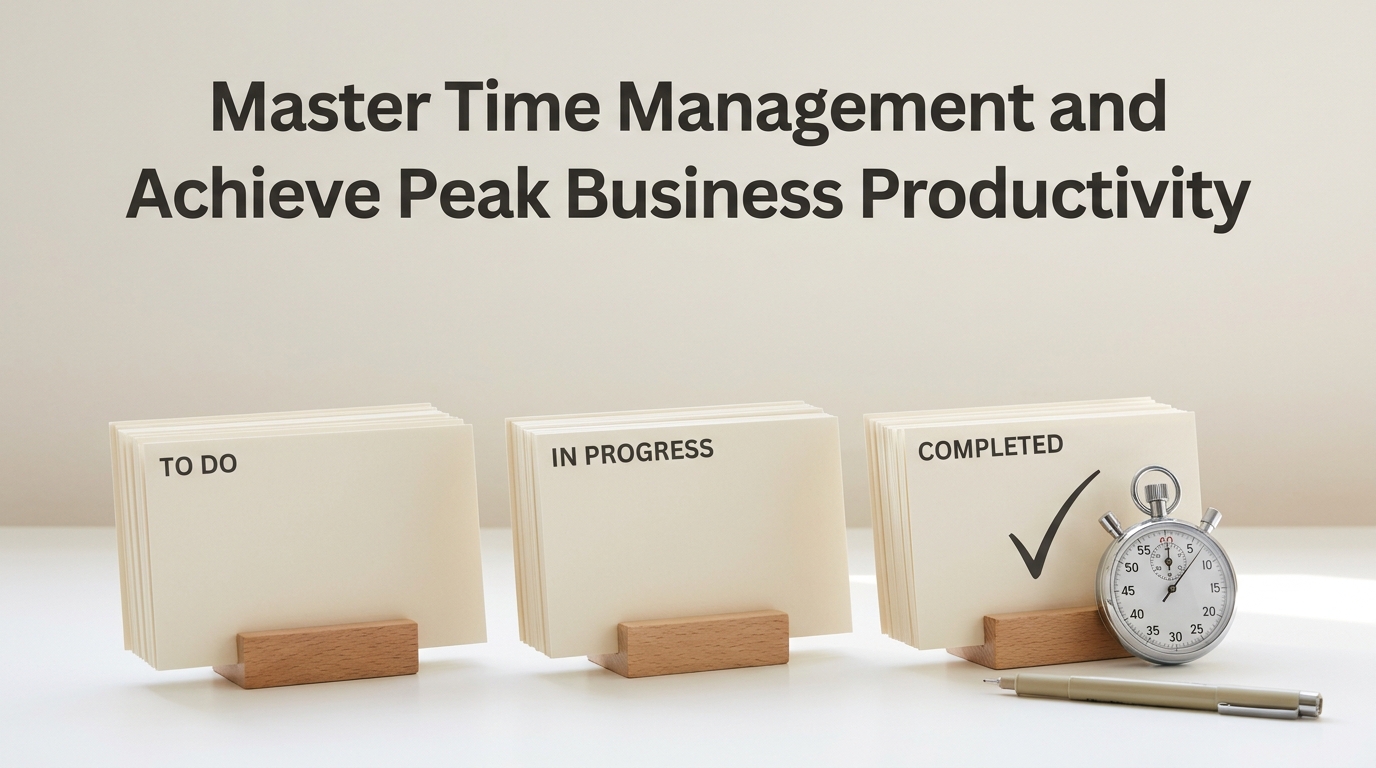
Master Time Management and Achieve Peak Business Productivity
Have you ever finished an extremely busy workday only to feel like no truly important project was completed? This phenomenon frequently plagues professionals and managers across various industries. Many people get trapped in a vortex of daily tasks without a clear direction. Yet, mastering time management remains the master key to achieving peak work performance without sacrificing work-life balance.
Implementing effective time management strategies is not merely about working faster or extending work hours late into the night. It focuses on managing energy, setting priorities, and choosing a workflow tailored to individual working styles. Through a systemic approach, you can transform how you view your daily to-do list and consistently hit your business targets.
Why Many Professionals Fail at Time Management

Failing to manage a daily schedule is rarely caused by laziness. Instead, the root of the problem often lies in unclear priorities and choosing the wrong methods. When every task appears equally important, decision fatigue sets in. This condition triggers procrastination and leads to overdue work.
Many professionals rely on memory or random notes to manage their responsibilities. This conventional method is now inadequate for managing the intricacies of today’s work environment, which is laden with digital interruptions. Without a structured workflow, you will constantly react to incoming emails, instant messages, and last-minute meetings.
To overcome these challenges, apply essential business productivity tips centered around choosing proven frameworks. Understanding the flaws in your current workflow is the first step toward sustainable efficiency.
Four Main Time Management Frameworks and How They Work
Every time management system has its unique strengths. No single method fits everyone because every professional has a distinct work rhythm and set of responsibilities. Below is an in-depth breakdown of four popular systems proven to boost workplace efficiency.
Getting Things Done (GTD): A Mind Management System
Created by renowned productivity expert David Allen, the core principle of GTD is offloading all mental burdens and ideas from your head into a trusted external tracking system. The human brain is naturally designed to process ideas, not to store complex schedule information.
The GTD workflow consists of five main steps: capture all ideas, clarify their meaning, organize tasks into appropriate lists, reflect regularly, and engage in meaningful action. This method is ideal for professionals handling multiple simultaneous projects who need a comprehensive view of all their responsibilities. Comprehensive information on this methodology can be accessed directly on the official David Allen Company website.
The Eisenhower Matrix: Sorting Urgency and Importance
Developed from concepts by Dwight D. Eisenhower and popularized by Stephen Covey, this framework divides tasks into four quadrants based on priority. The horizontal axis represents urgency, while the vertical axis determines the importance of a task.
| Quadrant | Category | Action |
| Quadrant 1 | Urgent & Important | Do Immediately |
| Quadrant 2 | Not Urgent & Important | Schedule Dedicated Time |
| Quadrant 3 | Urgent & Not Important | Delegate to Team |
| Quadrant 4 | Not Urgent & Not Important | Eliminate from Schedule |
This matrix trains you to decline requests that add no value to core business goals. Successful professionals spend most of their time in Quadrant 2 focusing on strategic planning and self-development.
Time Blocking: Allocating Dedicated Distraction-Free Focus Time
The Time Blocking method allocates specific time slots in a daily calendar to complete distinct task categories. Rather than maintaining an endless to-do list, this workflow provides certainty on exactly when a task will be tackled.
By applying this method, you dedicate uninterrupted focus time free from meeting calls or instant message replies. This practice protects deep focus when tackling complex analysis, strategy formulation, or critical document drafting.
The Pomodoro Technique: Maintaining Focus and Workflow Rhythm
If your focus breaks easily when facing major projects, the Pomodoro Technique offers a practical solution. This method breaks work sessions into 25-minute intervals of deep focus, separated by 5-minute short breaks.
Once you’ve finished four focus sessions, you take an extended break lasting 15 to 30 minutes.
This structured rhythm prevents mental fatigue, maintains steady motivation, and helps precisely estimate how long tasks will take.
Comprehensive Comparison of Productivity Frameworks
Choosing the right method requires understanding the unique characteristics of each system. The following comparison table summarizes the key differences among the four frameworks.
| Framework | Key Advantage | Best Suited For | Implementation Challenge |
| GTD | Reduces mental burden and anxiety | Managers handling complex, multi-layered projects | Requires daily review discipline |
| Eisenhower Matrix | Clarifies priority scales clearly | Decision-makers and team leaders | Accurately defining what is genuinely urgent |
| Time Blocking | Minimizes multitasking and distractions | Deep thinkers and creative professionals | Demands a rigid calendar schedule |
| Pomodoro | Enhances daily focus stamina | Executing routine or technical tasks | Less suitable for flexible meetings |
Guide to Choosing a Framework Tailored to Your Work Style
Finding a system aligned with your work rhythm requires observing daily habits. An ideal workflow should support flexibility without compromising primary business performance targets.
Identifying Your Daily Bottlenecks
The first step is diagnosing the primary source of friction in your routine. If your challenge lies in figuring out where to start each morning, the Eisenhower Matrix offers the fastest fix. If distractions stem from incoming instant messages, implementing Time Blocking provides a solid shield for focus time.
Meanwhile, for professionals exhausted by floating ideas without execution, the GTD framework provides a highly organized mind-mapping structure. Matching the method to your specific bottleneck yields significant productivity gains.
Combining Multiple Strategies
You do not need to restrict yourself to a single method. Many successful practitioners combine several frameworks to build a flexible, personalized workflow. As a recommendation, you can use the Eisenhower Matrix to prioritize weekly goals, then execute those priorities using Time Blocking alongside daily Pomodoro intervals.
This synergy across frameworks strengthens critical leadership skills for professionals at various management levels. Alignment between workflow and priorities builds sustainable efficiency without triggering burnout.
Digital Tools to Optimize Time Management
Modern technology offers various software tools designed to support actionable time management strategies. Choosing the right software accelerates adaptation to a new workflow.
- Task Management Apps: Tools like Todoist, Notion, or Asana simplify task visualization and organize GTD lists neatly.
- Digital Calendars: Google Calendar and Outlook support Time Blocking implementation through visual color-coding for easy schedule categorization.
- Focus Timers: Apps like Forest or Focus Booster help run Pomodoro sessions without social media distractions.
Digital tool adoption should match genuine needs so software management does not become an added burden in your work routine.
Practical Steps to Start Transforming Your Schedule Today
Transforming work habits cannot happen overnight. A gradual approach yields far more consistent and long-lasting results.
- Choose One Primary Framework: Begin by adopting a single method for two full weeks without drastically overhauling your entire workflow.
- Evaluate Your Routine: Note friction points arising during the trial period to identify necessary adjustments.
- Optimize Tool Usage: Use the simplest supporting apps to capture and organize your daily work schedule.
- Maintain Review Consistency: Set aside 15 minutes every weekend to plan the upcoming week’s agenda and priorities.
Frequently Asked Questions About Time Management
How Long Does It Take to Master a New Productivity System?
Adapting to a new productivity workflow generally takes around 21 to 30 days before becoming an automatic habit. The key to success lies in daily consistency rather than flawless execution from day one.
Is the Pomodoro Technique Effective for Creative Work?
The Pomodoro Technique is highly effective for creative tasks because it mitigates mental burnout during intense brainstorming sessions. However, you can extend focus intervals to 45 or 60 minutes if deep creative flow requires uninterrupted work.
How Should You Handle Urgent Tasks Assigned by Leadership?
Use Eisenhower Matrix principles to evaluate task urgency alongside your manager. If the new request is genuinely urgent and important, adjust your schedule allocation and delegate or postpone lower-priority tasks.
Is the GTD System Too Complex for Beginners?
While the GTD system features detailed logging upfront, beginners can start with its core principle: capturing all ideas into a single inbox before organizing them into actionable lists.
How Can You Overcome Mental Fatigue Caused by Heavy Schedules?
Preventing mental fatigue requires intentionally scheduling rest breaks in your daily calendar. Avoid filling every time block back-to-back, and establish clear boundaries between work hours and personal time.
Mastering diverse time management techniques has a profound impact on long-term productivity and career balance. Understanding the nuances between GTD, the Eisenhower Matrix, Time Blocking, and Pomodoro empowers you to choose strategies tailored to daily challenges.
Boost your work efficiency today by selecting the system best suited to your personal rhythm. Evaluate and refine your workflow regularly to achieve peak business productivity with ease.