
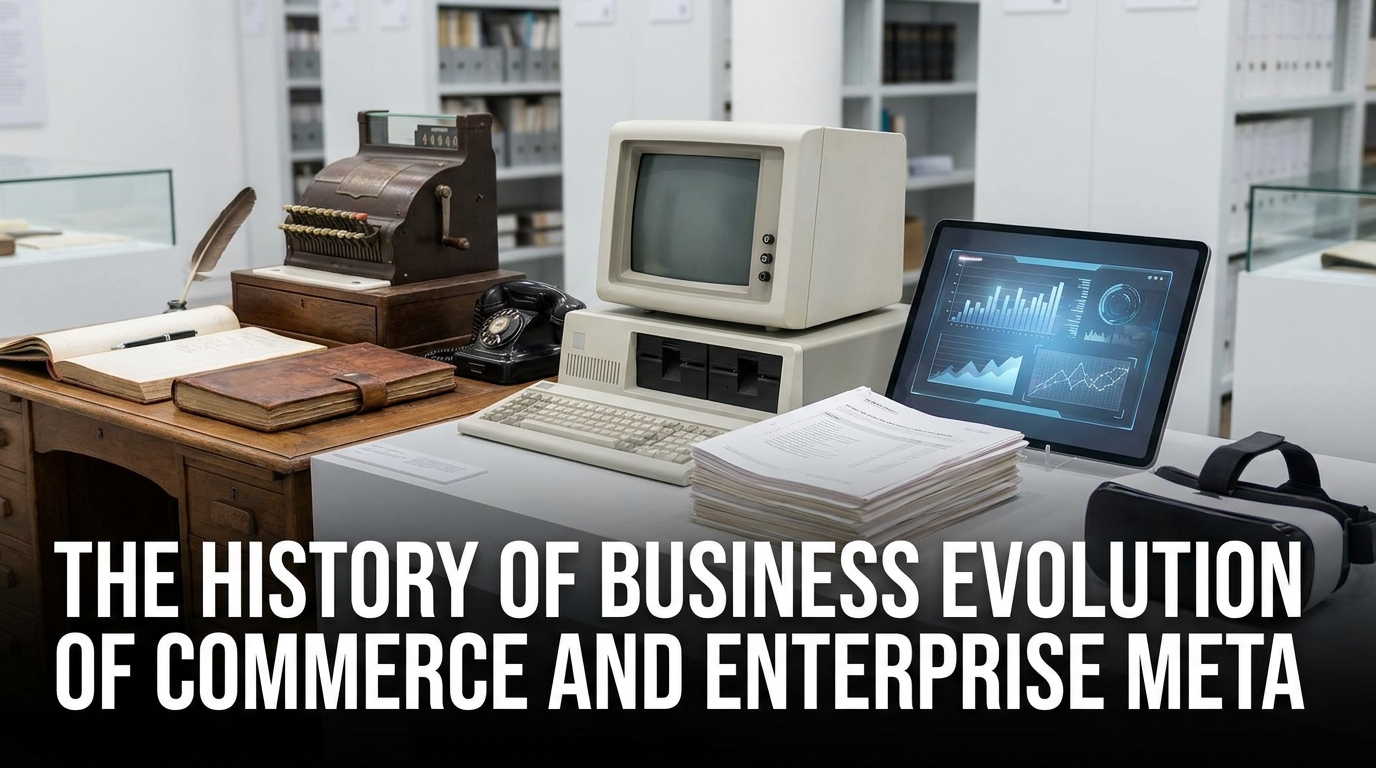
The History of Business Evolution of Commerce and Enterprise Meta
The system of exchanging goods has served as the primary engine of human civilization for thousands of years. Long before currency was invented, ancient societies relied on barter mechanisms to meet their daily needs. As populations grew and needs became more complex, that method began showing clear limitations. The transition toward standardized exchange mediums marked the beginning of a new chapter in civilization. A deep understanding of the history of business offers a clear picture of how innovation, risk-taking, and technological adaptation shaped the modern economic structures we enjoy today.
Foundations of Ancient Trade and the Silk Road
The development of the global economy is rooted in extensive cross-regional trade networks. In ancient times, interactions among nations were forged through land and sea routes stretching from Asia to Europe. The civilizations of Mesopotamia and Ancient Egypt pioneered transaction recording using clay tablets. This step became the forerunner of the modern accounting systems we know today.
Interestingly, the existence of the Silk Road accelerated the exchange of high-value commodities such as silk, spices, and ceramics. This network facilitated not only physical transactions but also cultural exchange, scientific knowledge, and craftsmanship technologies. These advancements laid a vital foundation for the history of global trade that connected various continents in a mutually dependent economic ecosystem.
Merchants of that era had to face unpredictable seafaring conditions and the threat of piracy. These extreme circumstances sparked early forms of trade partnerships known as merchant guilds. Through these organizations, traders shared financial risks and strengthened their bargaining power in foreign markets. Detailed accounts of this system’s development can be further explored through the Britannica Encyclopedia on Trade History as a comprehensive historical reference.
Merchant Capitalism and the Birth of the Modern Corporation

Entering the 16th century, the global economic map underwent a radical shift with the emergence of mercantilism and merchant capitalism. European nations vied to accumulate wealth through territorial expansion and trade monopolies. This changing social structure demanded a far more organized and heavily capitalized business model.
A monumental leap occurred when the East India Company was established as a corporate entity. This enterprise introduced the concept of the Joint-Stock Corporation, allowing the public to purchase ownership shares and distribute investment risks proportionally. This corporate structure became a crucial stepping stone in the history of entrepreneurship, as it enabled the pooling of vast capital without burdening a single individual with all the risk.
Meanwhile, banking innovations in Italy and the Netherlands accelerated financial transaction growth. The use of promissory notes and checks simplified long-distance payments without requiring the physical relocation of precious metals. The success of these financial instruments proved that adapting to market flexibility strongly determines business survival. For modern business practitioners, implementing a well-crafted risk management strategy remains essential when navigating constantly changing market dynamics.
The Industrial Revolution and Mass Production Efficiency
The 18th century brought a massive wave of disruption through the Industrial Revolution in Britain. James Watt’s invention of the steam engine dramatically altered how goods were manufactured and distributed. Traditional manufacturing systems that relied on human and animal labor were gradually replaced by high-speed machinery inside factories.
This technological shift fueled the history of successful companies across manufacturing, textiles, and railway transportation sectors. Mass production significantly lowered manufacturing costs, making commercial products accessible to broader segments of society. On the other hand, standardized working hours, the division of labor, and strict operational management were introduced to maintain factory efficiency.
What’s more, the wave of historical events during this period reshaped demographic maps on a massive scale. Large-scale urbanization occurred as millions of people migrated from rural areas to urban industrial centers. Consequently, a new working class and a domestic consumer market far larger than those of previous centuries emerged.
The Information Era and Digital Economy Transformation
By the mid-20th century, global business focus pivoted from heavy manufacturing to information processing and technology. The advent of personal computers, microprocessors, and the internet birthed a rapid, borderless economic landscape.
Silicon Valley in the United States grew into a global center of technological innovation. Numerous startups emerged with disruptive business models that challenged established incumbents. Tech giants like Microsoft, Apple, Amazon, and Google redefined how humans communicate, shop, and work. The evolution of commerce from physical storefronts to e-commerce platforms enabled cross-border transactions to occur in mere seconds.
As a matter of fact, the digital era has also transformed what constitutes a company’s most valuable assets. Physical wealth in the form of land and factories is no longer the sole indicator of market dominance. Data, intellectual property rights, and software algorithms now hold center stage in determining a company’s valuation in the eyes of global investors.
Leadership Lessons from Past Centuries for Modern Entrepreneurs
Examining the historical journey of commerce offers valuable perspectives for contemporary business leaders. Even as technology and transaction mechanisms continuously evolve, core principles of business sustainability reflect similar patterns throughout time.
- Adaptability to technological change: Companies that refuse to move away from legacy systems risk being erased by new innovations, just as happened during the transition of the Industrial Revolution.
- Diversification and risk management: Applying risk-sharing principles, akin to merchant guilds and Joint-Stock Corporations, has proven to sustain organizational resilience during crises.
- Focus on solving consumer problems: Business entities that survive for centuries consistently focus on providing genuine solutions to real societal needs.
- The importance of flexible organizational structures: Rigid organizations tend to respond slowly to market dynamics compared to more agile competitors.
Interestingly, the founders of successful companies in every era shared one common trait: the courage to explore uncharted territory before others even recognized its potential. This mindset is immensely relevant as we navigate today’s wave of Artificial Intelligence integration.
Studying the long history of business proves that change is the only constant in the commercial world. From primitive commodity bartering and expanding international trade routes to modern AI integration, business consistently finds ways to adapt and grow. For modern entrepreneurs and professionals, understanding these historical roots is not merely an academic exercise, but a means to sharpen strategic foresight. Applying principles of adaptability and forward-looking leadership will help build resilient enterprises ready for the future.
How Did the Barter System Transition into the Use of Currency?
The barter system suffered from a fundamental flaw known as the double coincidence of wants, where two parties had to simultaneously desire what the other offered. To resolve this inefficiency, ancient societies began using intrinsic items like salt, cowrie shells, and precious metals as standardized values. Over time, kingdoms and governments minted official metal coins to guarantee weight and purity, which eventually evolved into paper currency and modern digital money.
What Was the Significance of the East India Company in Corporate History?
The East India Company is considered a pioneer of the modern corporation because it was among the first to issue public shares through a Joint-Stock Corporation structure. This framework allowed the enterprise to raise vast capital from numerous investors while limiting individual financial liability to the amount invested. This model of corporate governance and capital raising served as the blueprint for limited liability companies worldwide.
Why Was the Industrial Revolution a Major Turning Point in Global Business?
The Industrial Revolution shifted the foundation of business from small-scale craftsmanship to large-scale mechanized manufacturing. This phenomenon introduced concepts of production efficiency, structured division of labor, and significant reductions in product costs. Furthermore, it spurred infrastructure developments such as railways and steamships, enabling faster and broader product distribution across the globe.
How Has the Internet Transformed Traditional Business Models?
The internet dismantled geographical barriers and streamlined lengthy distribution chains that were standard in traditional trade. Digital platforms enabled manufacturers to sell directly to end consumers (direct-to-consumer). Additionally, the internet gave rise to subscription-based business models, digital marketplaces, and data-driven marketing strategies tailored to consumer behavior.
Why Should Modern Entrepreneurs Study Historical Trade Patterns?
Understanding trade history offers deep insights into market shifts, crisis management, and innovation cycles. History demonstrates that long-lasting companies are not necessarily the largest, but the most adaptable to changing times. By evaluating past successes and failures, modern entrepreneurs can make sharper strategic decisions and avoid repeating historical missteps.